
— CASE STUDY: MARKETING 360 AI INITIATIVES LEADERSHIP
Leading AI Integration Across a Multi-App Marketing Platform
Leading a cross-functional project to integrate agentic tools, intelligent onboarding, and generative AI across teams, codebases, and a completely new design frontier in Marketing 360.
Platform
Web Application
Product
Marketing 360 Platform
Role
UX Strategic Owner
Team Model
Fully Distributed
Overview
A platform-wide opportunity that required platform-wide coordination
Marketing 360 is a comprehensive marketing platform serving tens of thousands of small and mid-sized businesses. It includes several distinct applications, each with its own user base, workflows, and sometimes even its own codebase, including websites, CRM, email, social media, advertisements, and more.
When it came time to incorporate AI throughout the platform, there were organizational as well as design challenges. The vision needed to be established, stakeholders from the C-suite, product, engineering, and content leadership needed to be aligned, and the experience needed to feel cohesive rather than piecemeal. I was given that role.
I oversaw the entire AI integration project, directing strategy, leading my UX team through implementation, creating design patterns that could be applied to other apps, and integrating myself into the cross-functional teamwork needed to complete the project. This is the story of how that happened.
Stakeholders and Collaboration
Many rooms. Many voices. One coherent direction
A design silo is not where a platform-wide AI project is developed. Every feature needed support and feedback from those who would be impacted by it or who would be in charge of implementing it. This was more difficult, but it was also more deliberate because I worked in a completely remote setting.
C-SUITE STAKEHOLDERS
Strategic alignment, initiative sponsorship, and priority-setting for which AI capabilities to pursue first.
PRODUCT OWNERS & MANAGERS
Requirements scoping, roadmap integration, and the bridge between business goals and buildable features.
UX TEAM
My direct collaborators. I led and facilitated the team’s execution of the design, including user testing, prototypes, and patterns.
DEVELOPMENT TEAMS
Multiple engineering teams across distinct codebases. Close coordination ensured AI patterns translated consistently.
INTERNAL CONTENT LEADERSHIP
The internal content team’s workflows were directly impacted by AI generation tools and had to be accounted for.
“A platform this wide doesn’t change direction quietly. Alignment had to be built continuously. In product reviews, design critiques, and one-on-ones across every corner of the org.”
— PRINCIPLE GUIDING THE INITIATIVE
The Challenge
New territory. No established map
When we first started this project, the integration of AI in marketing platforms was only just beginning to be taken seriously. Our competitors were releasing small experiments. Usage patterns were still very much in flux. Most importantly, there was no playbook established for the role of generative AI in a complex, multi-surface product.
That gave us a unique situation. Not only were we fresh enough to define the norm, but we also didn’t have the comfort of industry precedent to fall back on. Practically every single aspect of our work from deciding how to prompt generation to how to deal with multi-app consistency was reliant on coming up with new ideas and then backing them up with research and iteration.
On top of that, the tech situation didn’t make it easy. Marketing 360’s various applications are not all parts of a single codebase. Creating one unified AI experience for the various apps, which had been developed by different teams and run on different foundations, turned out to be a design system task and required a close working relationship with developers on a regular basis.
BEFORE:
The gaps AI needed to close
- Small businesses lacked in-house copywriting and design skills, creating friction across the platform
- New users were dropped directly onto the main dashboard with no guided orientation, leading to low activation rates
- Content creation, especially for blogs and campaigns, was slow and manual
- No competitive parity with platforms actively marketing AI capabilities to the same audience
- Campaign monitoring required manual effort and there was no proactive intelligence layer
AFTER:
What the AI initiative delivered
- Generative copy and image creation embedded directly into existing workflows
- An AI-powered onboarding flow that oriented new users through conversation, not instruction
- Bulk content generation tools that accelerated client and internal team output dramatically
- An agent panel surfacing personalized recommendations and market intelligence for each business
- Agentic campaign monitoring with a conversational interface for live campaign Q&A
Key Features
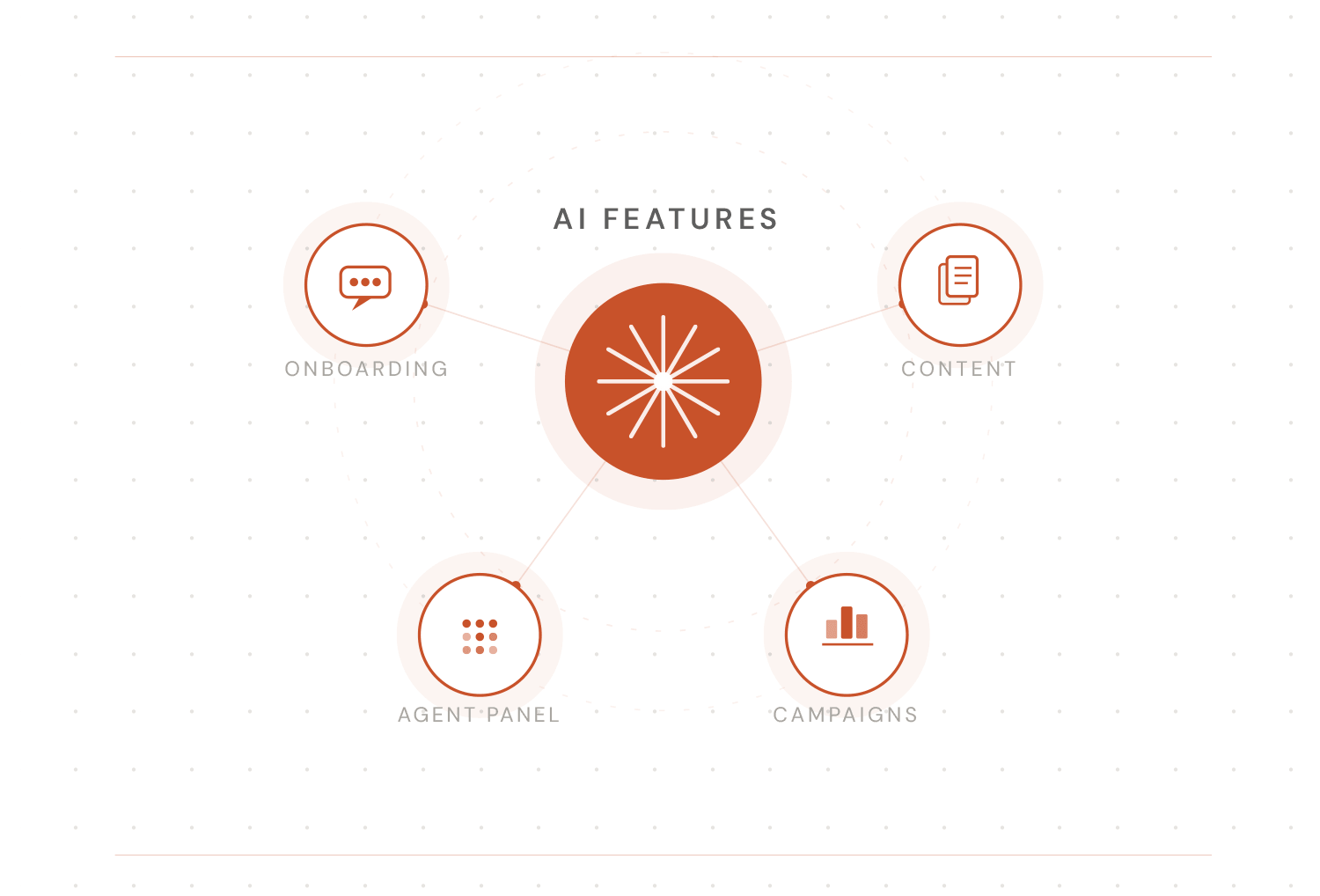
Four pillars of the AI integration
The initiative wasn’t a single feature. It was a coordinated series of AI integrations, each targeting a distinct user need. Below are the four defining pillars and the design thinking behind each.
ONBOARDING
AI-Guided Onboarding — Activation by Conversation
Instead of depositing new users onto a blank dashboard, we designed an AI-powered chat-based onboarding flow. The chat asked questions about the business which included its name, industry, location, services, and mission statement. Those answers populated the business profile, seeded the website builder, and generated a set of example marketing campaign ads, giving users an immediate, personalized preview of what the platform could do for them specifically. For users who already had a website, the onboarding flow included a site-scanning agent that pulled in brand details and existing content automatically. The impact was significant, we saw a 30% increase in conversion rate. Showing the platform’s power in the first session rather than making users discover it proved to be the most effective activation mechanism we deployed.
IMAGE & COPY GENERATION
Inline Generative AI — Writing and Visuals, In Context
Across the website builder, blog, and campaign creators, we integrated generative copy and image creation directly into existing workflows. Users could generate, refine, or remix content without leaving the surface they were already working in. The design principle was consistent across every touchpoint. AI assistance should appear at the moment of need, not require a detour to reach it.
CONTENT GENERATION
Content Marketing Pro — Scale Without Sacrifice
The Content Marketing Pro tool addressed one of the most time-consuming workflows on the platform, which was blog content creation. The headline capability was bulk generation. Users could produce up to 10 blog posts in a single session. This was transformative both for clients who struggled to maintain content velocity and for our internal content teams who were producing content at scale on behalf of clients. The tool wasn’t just faster. It gave smaller businesses a content strategy that had previously been out of reach.
AGENTIC AI
Agent Panel — Intelligence Layer for Every Business
The agent panel was the initiative’s most forward-looking element. Grounded in each user’s onboarding goals, it surfaced business specific recommendations, performance targets, and AI-driven market intelligence relevant to their industry and location. It also powered agentic campaign monitoring. Clients could open a chat interface and ask natural language questions about their active advertising campaigns, receiving data grounded answers without having to dig through dashboards or reports.
Design Process
How we approached building for a frontier with no established rules
With AI UX patterns still evolving industry-wide, our process was deliberately iterative and research forward. We treated each feature area as a design experiment which was informed by the best available evidence, validated quickly, and refined based on what we learned.
01
Cross-departmental requirements gathering
Before design work began, I facilitated structured requirements sessions with stakeholders across the business which included high level stakeholders, product management, and client-facing teams. Understanding how AI could genuinely help each group’s workflows (rather than just shipping AI features) was critical to building things that would actually get used.
02
Competitive analysis & AI UX research
We conducted a thorough audit of AI integration approaches across peer platforms and adjacent tools. Not just examining what features existed, but how they were surfaced, triggered, and integrated into existing workflows. Because the space was still forming, this research was as much about identifying what not to do as what to emulate.
03
Pattern definition & design system alignment
One of my most important contributions was establishing shared AI interaction patterns — consistent trigger mechanisms, generation states, output presentation, and error handling — that my team could apply across all app interfaces. Given the diversity of Marketing 360’s codebases, this design-system-level thinking was essential to delivering a coherent experience across apps built on different foundations.
04
Guided execution with the UX team
I directed and supported my team through design execution across the initiative’s feature pillars. Working remotely, I built a collaborative rhythm of design reviews, async feedback, and structured critiques that kept work moving and quality high without requiring everyone in the same room.
05
Developer partnership across codebases
Consistency was the hardest engineering constraint of the initiative. I worked closely with multiple development teams. Often navigating the handoff differently depending on each team’s stack to ensure that AI interaction patterns held up through implementation. Design specs were written with codebase variance in mind, and I stayed involved throughout builds to catch drift early.
06
Experimentation, testing & iteration
Because AI usage patterns were unsettled, testing was built into the process rather than treated as a final gate. We ran internal validation sessions, iterated on high uncertainty interactions, and used post-launch data to drive refinement. The team operated with a build-measure-learn mindset throughout. We were shipping things we were confident in while staying honest about what still needed validation.
Key Findings
What this initiative taught us about AI at platform scale
FINDING 01
Onboarding is a product’s most powerful AI use case
The 30% conversion lift from AI onboarding was the single largest measurable outcome of the entire initiative. Helping new users experience the platform’s value immediately, through conversation rather than exploration, proved more impactful than any generation feature. Orientation is often underestimated as a design problem. AI makes it a competitive advantage.
FINDING 02
Consistency across codebases doesn’t happen by accident
Before design work began, I facilitated structured requirements sessions with stakeholders across the business — high level stakeholders, product management, and client-facing teams. Understanding how AI could genuinely help each group’s workflows (rather than just shipping AI features) was critical to building things that would actually get used.
FINDING 03
Bulk generation changes what’s possible for smaller teams
The ability to produce up to 10 blog posts in a single session with Content Marketing Pro didn’t just save time, it fundamentally changed what content marketing looked like for small businesses and the internal teams supporting them. Volume tasks that were previously out of reach become accessible when AI handles the “blank slate” problem. The efficiency gains compounded quickly.
FINDING 04
Agentic AI works best when grounded in the user’s own context
The agent panel’s value depended entirely on how well it understood each individual business. AI suggestions and market intelligence that felt generic were ignored; those that connected to the user’s onboarding declared goals and their specific industry and location got acted on. Context awareness isn’t just a nice-to-have in agentic products. but also it’s the mechanism that makes them useful.
FINDING 05
Early movers carry the cost of the unknown and the reward
Being on the cusp of AI integration in a platform like Marketing 360 meant operating without established UX conventions to lean on. That required more experimentation, more tolerance for iteration, and more honest conversations with stakeholders about what we knew versus what we were learning. It also meant that the patterns we established became the foundation and not someone else’s playbook.
Outcomes
Competitive pressure as a design constraint
The AI integration initiative delivered across four major pillars of the Marketing 360 platform, with measurable impact on conversion, efficiency, and competitive positioning. It also established a scalable AI design foundation the platform can continue to build on.
ONBOARDING
30% conversion rate lift
Reviewed Canva, Wix, Shopify and Squarespace’s AI writing tools to identify UX patterns users were already being trained on.
INTELLIGENCE
Agentic campaign monitoring
Clients gained a conversational interface for querying live ad campaigns, reducing the need for manual dashboard analysis.
CONTENT
Bulk generation at scale
Content Marketing Pro enabled clients and internal teams to produce up to 10 blog posts per session, dramatically increasing content velocity.
PLATFORM
Consistent AI experience
Shared AI interaction patterns delivered a coherent feel across Marketing 360’s multi-app, multi-codebase suite.
STRATEGY
Competititve positioning
The initiative closed the AI capability gap with competitors and established Marketing 360 as a forward looking AI-integrated platform.
FOUNDATION
Scalable AI design system
AI patterns, triggers, and generation states are now codified. Future AI capabilities can build on this foundation without starting from scratch.
The Numbers That Tell the Story
%